
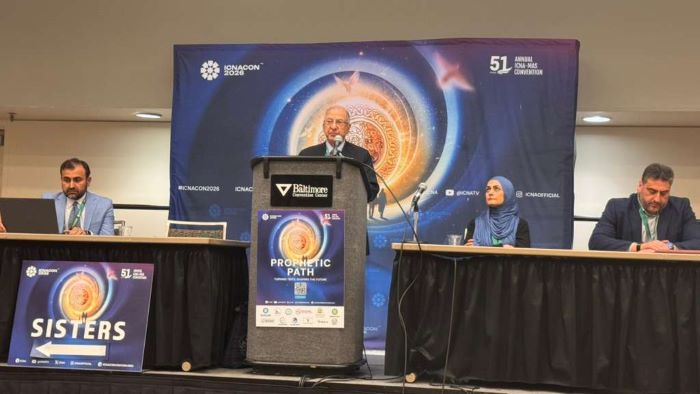
Kashmir: Occupation, Erasure, and a People Still Waiting, Says Dr. Ghulam Nabi Fai at ICNA Convention 2026
Share, Comment, Like, and Subscribe to support Independent Journalism!
By Adam Rizvi | Editor-in-Chief, The India Observer (TIO): BALTIMORE, MD — Speaking at the 2026 annual convention of the Islamic Circle of North America (ICNA) in Baltimore, Dr. Ghulam Nabi Fai delivered a forceful and deeply reflective address titled “Kashmir: Occupation, Erasure, and a People Still Waiting,” focusing on what he described as the continued denial of the Kashmiri people’s internationally recognized right to self-determination.
The session formed part of ICNA’s widely attended “Muslims Around the World Series,” which highlighted humanitarian and political crises affecting Muslim communities globally. Other speakers included Laila El Haddad, who addressed the situation in Palestine; Osama Abuirshaid, Chairman of the US Council of Muslim Organizations (USCMO); and Habibullah Ziar, who discussed developments in Afghanistan. The session was facilitated by Brother Ismael, recognized by attendees for his experienced moderation and leadership.
Also Read: ‘Saffron Kingdom’- a haunting response to “Kashmir File”
Dr. Fai, who also serves as Secretary General of the World Kashmir Awareness Forum, reminded the audience that the Kashmir dispute is not merely a territorial disagreement between India and Pakistan, but fundamentally concerns the political future, dignity, and human rights of more than twenty-three million people of Jammu and Kashmir. He stressed that the unresolved conflict continues to pose a threat to regional and international peace because of the nuclear capabilities of both neighboring countries.
Referring to historical international positions on Kashmir, Dr. Fai cited United Nations Security Council Resolution 47 adopted on April 21, 1948, which called for the future of Kashmir to be determined through the will of its people under U.N. supervision. He noted that subsequent resolutions by the United Nations Commission for India and Pakistan (UNCIP) reinforced that commitment.
Also Read: From Karbala to Kashmir: The Message Behind a New York Aashoora March
At the outset of his remarks, Dr. Fai referenced the 2005 decision by the U.S. State Department to revoke the diplomatic visa of Narendra Modi, who was then Chief Minister of Gujarat, in connection with allegations arising from the 2002 Gujarat riots. He also referred to media reports and testimony presented before India’s Supreme Court related to the violence.
Throughout the address, Dr. Fai argued that Kashmir possesses several unique dimensions distinguishing it from other global conflicts. Among them, he said, are its internationally disputed status, the ongoing resistance movement against what he described as foreign occupation, and the prolonged silence of the international community regarding allegations of human rights abuses in the region.
Also Read: Foreign occupation is destroying the very fabric of Kashmiri society
A major focus of his remarks centered on the constitutional changes implemented after August 5, 2019, when India revoked Articles 370 and 35A of its Constitution. Dr. Fai alleged that millions of domicile certificates had since been issued to non-Kashmiris in an effort to alter the demographic composition of the territory. He further claimed that extensive land acquisitions and displacement of indigenous residents violated international humanitarian law and protections guaranteed under Article 17 of the Universal Declaration of Human Rights.
Referring to remarks attributed to former Indian Defense Minister A. K. Antony regarding land allocations to armed forces in Kashmir, Dr. Fai alleged that more than 250,000 acres of land had been acquired in recent years. Comparing the scale to the five boroughs of New York City, he described the policy as systematic dispossession of local communities.
Also Read: Pro-Palestine Kashmiri Shopkeepers hauled for anti-Zionist stance in Kerala
The speech also referenced comments and reports from various international organizations, journalists, and human rights advocates concerning conditions in Kashmir. Dr. Fai cited statements by Gregory Stanton of Genocide Watch, concerns raised by the Committee to Protect Journalists, remarks by former European parliamentarian John Cushnahan, and commentary by acclaimed Indian author Arundhati Roy regarding militarization in the region.
He additionally referenced international media reports, including coverage by The New York Times and HuffPost, concerning communication restrictions, civil liberties concerns, and political developments in Kashmir following the constitutional changes of 2019.
Dr. Fai also highlighted the cases of several Kashmiri political leaders, journalists, and activists, including Khurram Parvez, Yasin Malik, Shabir Ahmed Shah, Masarat Alam Bhat, Aasia Andrabi, Sofi Fehmeeda, Nahida Nasreen, and Irfan Mehraj, describing their detentions and prosecutions as part of what he characterized as a broader crackdown on dissent.
Also Read: The Kashmir Files – Bloodied and Gory, Sold out to RSS-BJP Agenda
Addressing the wider geopolitical implications, Dr. Fai warned that tensions between India and Pakistan continue to make Kashmir one of the world’s most dangerous flashpoints. He referenced past mediation remarks by Donald Trump and urged the international community to facilitate meaningful dialogue involving India, Pakistan, and representatives of the Kashmiri people.
Human rights advocates and members of the Kashmiri diaspora attending the convention expressed concern over what they described as worsening conditions in Indian-administered Jammu and Kashmir, including allegations of repression, arbitrary detentions, media restrictions, and demographic changes.
Several speakers and advocates warned that continued international silence could embolden policies undermining human dignity, religious freedom, and democratic rights. Calls were made for the United Nations, human rights organizations, civil society groups, scholars, and policymakers to increase awareness and engagement regarding the humanitarian dimensions of the Kashmir dispute.
Also Read: Kashmir Issue hogs limelight in Tamil film ‘Amaran’
Concluding his remarks, Dr. Fai stated that lasting peace in South Asia would remain elusive until commitments made to the people of Kashmir through United Nations resolutions were fulfilled in accordance with democratic principles and international law.
Among those attending and supporting the session were Sardar Zulfiqar Roshan Khan, Sardar Zarif Khan, and Sardar Shoaib Irshad, who commended ICNA leadership for organizing discussions focused on the challenges faced by Muslim communities around the world, particularly in Palestine, Kashmir, and Afghanistan.
Editorial Note from Adam Rizvi
As journalists, our responsibility is not to silence difficult conversations but to document them responsibly, ethically, and with factual clarity. Kashmir remains one of the world’s longest unresolved disputes, carrying profound humanitarian, political, and geopolitical implications. Regardless of political position, the suffering of civilians, concerns over civil liberties, and the urgent need for peaceful dialogue deserve international attention rooted in justice, restraint, and human dignity.
Have a story, event, or issue to report? Email your press release or tip to editor@ TheIndiaObserver@gmail.com — TIO covers news that
Read the full story and more updates at The India Observer.
Support independent journalism by sharing this article, commenting on the issue, and subscribing for future coverage.


