Monday Musings: America at 250, India at 79: Democracies, Freedoms and Unfinished Promises
Share, Comment, Like, and Subscribe to support Independent Journalism!
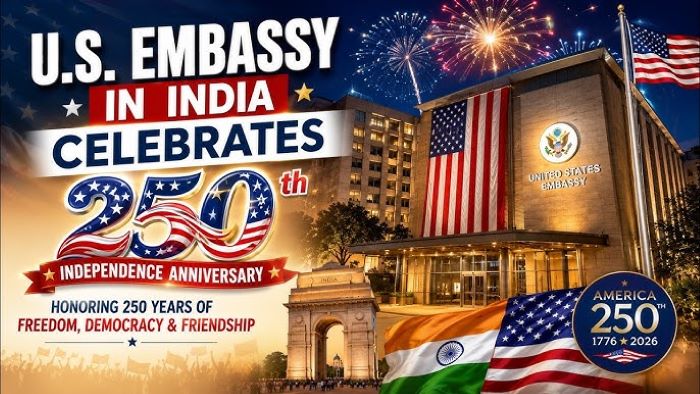
By Amitabh Srivastava | Edited By Adam Rizvi, The India Observer (TIO): Happy Independence Day: It was not surprising to see the Indian Prime Minister extend greetings to the President of the United States on the occasion of the 250th anniversary of American Independence.
Maintaining a democratic system of governance since July 4, 1776—despite numerous historical temptations to drift towards authoritarianism—is an achievement worthy of recognition. Many Indian newspapers, including Hindustan Times, The Indian Express, and The Times of India, have rightly praised the visionaries who drafted the American Constitution.
For journalists in India and elsewhere, where the media continues to serve as an instrument of accountability and checks and balances, the most significant legacy is not merely the Declaration of Independence but the First Amendment to the U.S. Constitution, which guarantees freedom of speech and of the press. That constitutional protection has remained one of the cornerstones of American democracy.
India, on the other hand, does not explicitly mention freedom of the press in its Constitution. Instead, press freedom has been interpreted as part of the freedom of speech and expression guaranteed under Article 19(1)(a), subject to the reasonable restrictions contained in Article 19(2). These freedoms have, at times, been curtailed, most notably during the Emergency (1975–77) and, critics argue, in parts of Kashmir and the North-East during periods of prolonged conflict.
The Second Amendment to the U.S. Constitution, meanwhile, guarantees the right to keep and bear arms. While this provision may have reflected the circumstances prevailing in the years immediately following the American Revolution, its relevance in contemporary America remains fiercely debated. Repeated incidents of school shootings and gun violence have fuelled calls for stricter gun control, yet the political influence of the gun lobby has made meaningful reform extraordinarily difficult, irrespective of which party occupies the White House.
In comparison, India, which will celebrate its 79th Independence Day on August 15, 2026, fares better in certain respects.
As Indu Rani Singh, Executive Director of Prayas JAC Society, who has spent a lifetime working for the protection of vulnerable children and women across several states, points out, despite its constitutional commitment to equality, the United States has yet to elect a woman President.
“I had obtained a biography of Kamala Harris in 2019, when she was Vice President, and I believed she deserved the opportunity to contest against Donald Trump. But that never happened. Earlier, Hillary Clinton mounted a strong challenge against Trump, but for whatever reasons, the American electorate ultimately chose Donald Trump.”
India, by contrast, has had a powerful woman Prime Minister and currently has a woman President. It has also had a woman Speaker of the Lok Sabha and, over the decades, women have occupied several of the country’s highest constitutional offices.
Also Read: Monday Musings: A Tale of Two Democracies
Constitutional experts also point to one of America’s enduring strengths: its robust judiciary and resilient federal system. These institutions enable political diversity and democratic competition. The rise of Zohran Mamdani, the son of acclaimed filmmaker Mira Nair, in New York politics reflects the ability of individuals with views markedly different from those of President Donald Trump and the MAGA movement to find democratic space within the American system.
Yet, despite the strengths of its constitutional framework, child rights advocates in India continue to express concern over one issue they find difficult to reconcile.
Nearly four decades after the adoption of the United Nations Convention on the Rights of the Child (UNCRC)—one of the most widely accepted human rights treaties in history, ratified by almost every country in the world—the United States remains the only UN member state that has not ratified it.
India ratified the Convention in 1992 and subsequently strengthened its child protection framework through institutions such as the National and State Commissions for Protection of Child Rights. The Delhi Commission for Protection of Child Rights (DCPCR) was among the bodies led in its formative years by Amod K. Kanth.
These institutional reforms contributed to the evolution of one of India’s most comprehensive child protection frameworks, anchored in the Juvenile Justice Act and related legislation. The law generally treats individuals below the age of 18 as children, while allowing exceptions for certain categories of heinous offences committed by those aged 16 to 18.
Child rights organisations such as Prayas point out that delegations from several countries have studied aspects of India’s child protection framework. They also note that in several countries, including parts of Europe and the United States, children can, under certain circumstances and depending on local laws, face prosecution or lengthy detention within the adult criminal justice system at much younger ages. These differences continue to generate debate among child rights advocates worldwide.
Also Read: Monday Musings: Prayas has its Thanks Giving day, courtesy Amod K Kanth
Just two days ago, Hindustan Times republished an article by the late Martin Luther King Jr., written decades ago, in which he paid tribute to the philosophy of Mahatma Gandhi.
History also reminds us that Martin Luther King Jr., like Mahatma Gandhi before him, fell victim to assassination.
Equally sobering is the reality that, despite the lofty ideals enshrined in the American Constitution and its founding documents, the United States continues to grapple with racial inequality. The Black Lives Matter movement, launched in 2013 in response to police brutality and systemic racism, remains a powerful reminder that the struggle for equal justice is far from complete.
Also Read: U.S. Elected Officials Speak About Threat Against India’s Constitution
The fireworks that illuminate the American sky every Fourth of July celebrate a remarkable democratic experiment. They also serve as a reminder that every democracy—whether America at 250 or India at 79—must continually strive to bridge the gap between its constitutional ideals and lived reality.
Curated By Humra Kidwai