A Silent Protest, A Powerful Legacy: How One Football Fan Brought Congo’s History Back Into the Global Spotlight
Share, Comment, Like, and Subscribe to support Independent and Fearless Journalism!
By Adam Rizvi | Editor-in-Chief, The India Observer (TIO): When millions around the world tuned in to watch the FIFA Club World Cup this week, few noticed a man dressed in a striking red suit standing motionless among the crowd. Those who did witnessed a silent act of remembrance and protest that quickly spread across social media and international news outlets.
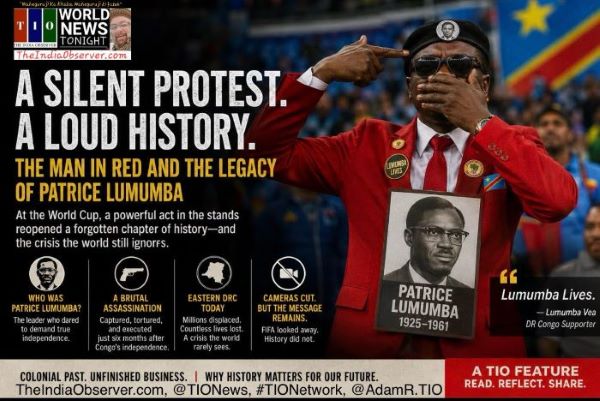
The man is Michel Kuka Mboladinga, widely known as “Lumumba Vea”—meaning “Lumumba Lives.” For years, he has attended matches involving the Democratic Republic of the Congo while standing in tribute to Patrice Lumumba, the country’s first democratically elected Prime Minister after independence from Belgium in 1960.
Read More: NYNJ Emerges as Global Hub for Teams Ahead of FIFA World Cup 2026™
During the match against Colombia, Lumumba Vea added another powerful gesture. Covering his mouth with one hand while pointing the other like a gun to his head, he sought to draw attention not only to Lumumba’s assassination but also to the ongoing humanitarian crisis in eastern Democratic Republic of the Congo.
According to international media reports, television cameras quickly moved away from the protest. Yet photographs and videos circulated worldwide, reigniting conversations about colonial history, political intervention, and one of today’s least-publicized humanitarian disasters.
Patrice Lumumba emerged as one of Africa’s most influential independence leaders during the wave of decolonization that swept across the continent after World War II.
Read More: Governor Sherrill Announces More Than 750 Free FIFA World Cup 2026 Tickets for New Jersey Residents
On June 30, 1960, as Belgium formally granted independence to the Congo, Lumumba delivered a historic speech before Belgium’s King Baudouin. Rather than offering ceremonial praise, he spoke candidly about decades of colonial exploitation, racial discrimination, forced labor, and the suffering endured by Congolese people.
His words inspired millions across Africa and the developing world.However, Congo soon descended into political turmoil. Amid Cold War tensions, Lumumba was removed from office, arrested, and in January 1961 was executed. Subsequent historical investigations and official inquiries have documented Belgian involvement in the events surrounding his death, while historians continue to debate the roles played by other foreign governments and intelligence agencies during that turbulent period.
Belgium has since acknowledged moral responsibility for aspects of the assassination, making Lumumba’s death one of the most significant and controversial episodes in post-colonial African history.
More than six decades later, eastern Democratic Republic of the Congo remains affected by armed conflict involving numerous militias and regional actors.
The region possesses vast reserves of cobalt, coltan, gold, and other minerals that are essential to modern technologies including smartphones, electric vehicles, and computers. At the same time, millions of civilians have experienced displacement, violence, food insecurity, and humanitarian hardship.
International organizations continue to describe the situation as one of the world’s largest humanitarian emergencies, although it often receives far less global attention than other conflicts.
Unlike demonstrations filled with slogans or banners, Lumumba Vea’s protest relied entirely on silence.
Standing motionless throughout the match, dressed in a vivid red suit, he transformed a football stadium into a place of historical remembrance.
Read More: Zohran Mamdani Pledges Universal Childcare to Address New York City’s Growing Affordability Crisis
His gesture reminded viewers that sporting events have frequently become platforms for raising awareness of social justice, human rights, and historical memory.
Whether one agrees with every political interpretation surrounding Congo’s past or present, the symbolism succeeded in encouraging people around the world to ask an important question:
For readers in India and across the South Asian diaspora, Lumumba’s story carries familiar echoes.
India itself experienced nearly two centuries of colonial rule before achieving independence in 1947. Across Asia, Africa, and Latin America, many nations continue to grapple with the long-term consequences of colonialism—economic inequality, political instability, contested borders, and struggles over natural resources.
Each country’s history is unique, yet the broader conversation about sovereignty, justice, and national development remains relevant across the Global South.
Editorial Note
At The India Observer, we believe journalism should not only report events but also provide historical context that helps readers understand why those events matter.
The silent protest witnessed at the FIFA Club World Cup was more than a viral moment. It served as a reminder that history often lives on through ordinary individuals determined not to let forgotten stories disappear.
Whether in Africa, Asia, Europe, or the Americas, understanding our shared history encourages informed discussion and greater appreciation of the challenges many nations continue to face today.
— The India Observer Editorial Team
Please read, share, and join the conversation. History matters because its consequences continue to shape our world.
Support independent journalism by sharing this article, commenting on the issue, and subscribing for future coverage.
Have a story, event, or issue to report?
Email your press release or tip to TheIndiaObserver@gmail.com— TIO covers news that matters. @AdamRizviTIO