
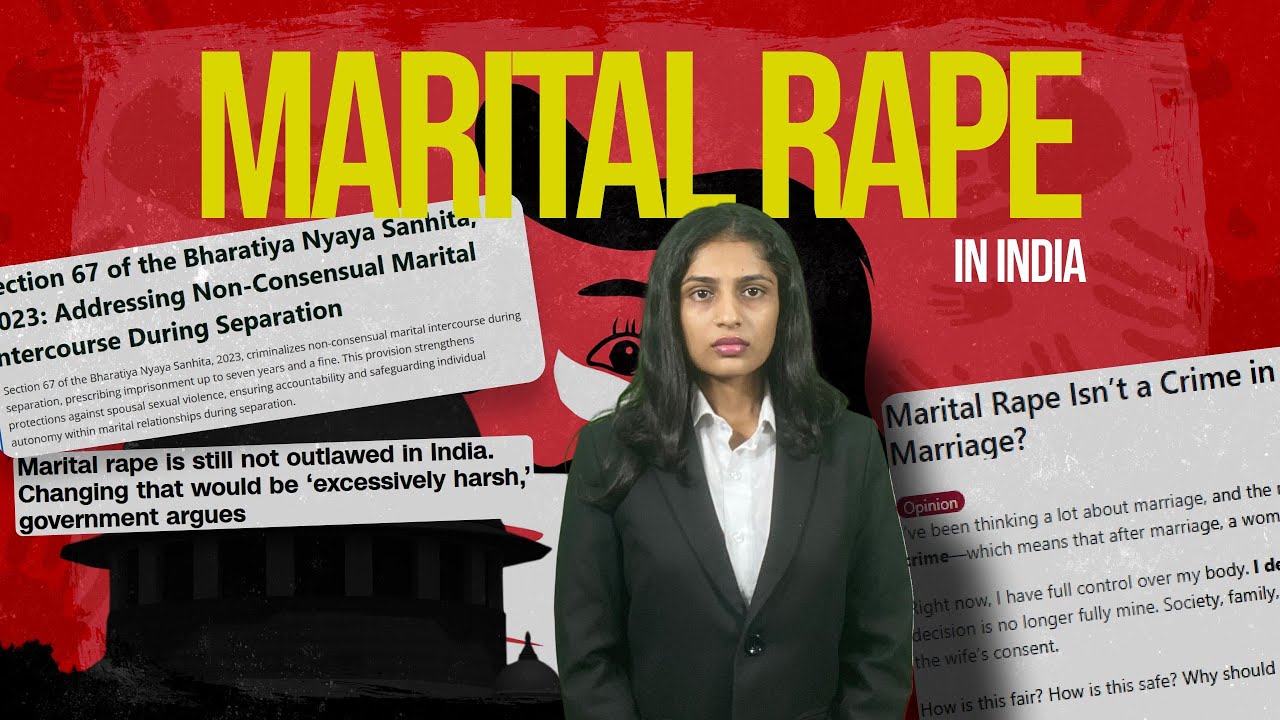
View Point: Marital Rape vs. UCC?
Share, Comment, Like, and Subscribe to support Independent Journalism!
By Amitabh Srivastava, Edited by Adam Rizvi, The India Observer, TIO: India watchers are shocked by the low priority the Modi government has accorded to the urgent issue of criminalising marital rape, particularly when the Ministry of Women and Child Development is giving top priority to ending child marriages with the help of NGOs.
So much so that the Just Rights group, comprising various organisations working to combat this social evil, has managed to secure the United Nations’ recognition of November 27 as the International Day for the Elimination of Child Marriage. The UN General Assembly adopted a resolution to this effect on September 6. India is a co-sponsor of this far-reaching resolution.
Also Read: Taslim Jahan, Rape and Murder Case Go Unsung
An article published by the Oxford Human Rights Hub points out that India’s National Family Health Survey (NFHS-5), covering 2019–21, reported that 32% of Indian women had experienced sexual or emotional violence perpetrated by their current husbands. The report also highlights the extent to which such abuse goes unreported.
Under Section 375 of the Indian Penal Code, now replaced by Section 63 of the Bharatiya Nyaya Sanhita (BNS), an exception effectively shields husbands from prosecution for non-consensual sexual intercourse with their wives, provided the wives are at least 18 years old. Previously, the age threshold was 15. The underlying assumption is that marriage itself constitutes consent to sexual relations, effectively granting husbands what amounts to a presumed right to force sex upon their wives.
Also Read: 13 Years of the Indian Spring: Remembering Nirbhaya and the Awakening of a Nation
Different courts have interpreted the issue in different ways. In a landmark judgment in 2022, the Karnataka High Court famously observed: “A man is a man; an act is an act; rape is a rape, be it performed by a man, the husband, on a woman, the wife.”
The High Court was guided by the recommendations of the Justice J.S. Verma Committee, constituted in 2013 following the horrific Nirbhaya case of December 2012.
The matter subsequently came before a three-judge bench of the Supreme Court, which stayed the Karnataka High Court’s order, observing that Exception 2 would remain in force unless the law was changed by the Supreme Court. Women’s rights organisations continue to argue that the exception applicable to wives aged 18 and above must also be removed, as marriage cannot be treated as blanket consent to sexual intercourse.
According to figures cited in international discussions on the subject, 142 of 198 countries have criminalised marital rape, while 49, including India, have yet to do so. The laws in seven other countries remain ambiguous.
In the United States, all 50 states have criminalised marital rape, although the scope of the offence and the exceptions vary. Twenty states reportedly have no exceptions, while 30 retain certain exceptions under specific circumstances.
Also Read: NJ OAG Charges Three Men in Child Trafficking and Sexual Assault Case
A report by UAVnet, a national online resource centre against domestic violence, categorises rape into three types:
A. Force-only rape
B. Battering rape
C. Sadistic rape
The report also points out that husbands who forcibly rape their wives may do so repeatedly, sometimes more than 20 times.
Can we expect similarly detailed studies from the NFHS in a country where the Delhi Police has faced allegations of groping and fondling women protesters, including women journalists, while also being accused of refusing to register First Information Reports (FIRs)? The registration of an FIR, where the law requires it, is a fundamental safeguard for citizens seeking justice.
Also Read: Monday Musings: Futility vs Utility
Under these circumstances, it is hardly surprising that a government perpetually in election mode has prioritised implementing a Uniform Civil Code (UCC) across the country by 2029.
When Union Home Minister Amit Shah declared last week that the UCC would be implemented in all 21 states governed by the BJP-led National Democratic Alliance (NDA) before 2029, he was hardly breaking new ground.
Far from it. He was simply following the party’s established agenda—a party that has changed its name over the years but, its critics would argue, has not changed its colours.
Also Read: Ostracism Of Indian Muslims
The UCC essentially refers to a common set of rules governing the personal and civil rights of Indian citizens, irrespective of their religion. These include marriage, divorce, adoption, maintenance, guardianship, inheritance and succession.
The debate over a common civil code for all citizens gained national prominence during the Shah Bano case, which made headlines decades ago and caused considerable embarrassment to the Congress government led by Rajiv Gandhi.
Arif Mohammad Khan, a prominent Congress leader at the time, became a nationally recognised figure after taking a stand against his own government. Yet he remained with the Congress for years before eventually leaving the party.
Also Read: Media Professionals Have No Dignity Left in India
Today, he is associated with the BJP and is among the relatively few Muslim public figures who have established a rapport with the saffron party.
The government is aware that a UCC cannot simply be implemented across the country with the stroke of a pen. Personal laws fall within the Concurrent List, and the legislative process involves constitutional and state-level considerations. The legal route to implementation depends on the specific legislation and the states concerned.
Uttarakhand has implemented its own UCC, while President Droupadi Murmu has also given her assent to the UCC legislation passed by Gujarat and Assam, as reported.
Also Read: Monday Musings: Feminism Is Out, Realism Is In
The celebrated English essayist Francis Bacon wrote in the 17th century about the limits of state interference in certain matters, including religion. But Bacon wrote in the language of an earlier age and, evidently, does not find much favour with the country’s new political establishment.
At present, different communities in India are governed by a combination of secular statutes and personal laws. Hindu personal law has been codified through legislation such as the Hindu Marriage Act, 1955, and the Hindu Succession Act, 1956. Christians and Parsis have their own laws governing marriage and divorce.
Muslim personal law, by contrast, remains largely uncodified, although pre-Independence central legislation introduced important statutory provisions, including the Muslim Personal Law (Shariat) Application Act, 1937, and the Dissolution of Muslim Marriages Act, 1939.
Preparing for 2029 while ignoring what is happening right under the government’s nose at Jantar Mantar, where protesters of different backgrounds and ages are demanding the resignation of the Chief Election Commissioner, could prove politically suicidal.
Also Read: Supreme Court Scraps Anti- Anti-Conversion Law in Uttar Pradesh
The larger question remains: why is the government so eager to push the UCC agenda while the urgent demand to criminalise marital rape continues to await a satisfactory resolution? A genuinely progressive approach to justice must address both questions of civil law and the fundamental right of every individual to bodily autonomy and dignity.
Also Read: Syed Ali Mujtaba invited to discuss ‘Safeguarding Children in India’s AI Future.’
The India Observer — Fearless Journalism. Facts Matter.
Read the full story at TheIndiaObserver.com
Support independent journalism by sharing this article, commenting on the issue, and subscribing for future coverage.
Have a story, event, or issue to report?
Email your press release or tip to TheIndiaObserver@gmail.com— TIO covers news that matters. @AdamRizviTIO
Also Read more from this Author: Monday Musings: 25 Years of 9/11
Curated by Humra Kidwai


