Media Professionals Have No Dignity Left in India
Comment, Like, and Subscribe to support Independent Journalism!
By Syed Ali Mujtaba, Edited by Adam Rizvi, The India Observer, TIO: Two female journalists who were allegedly brutally assaulted by Delhi Police at the Saket police station on September 3, 2026, have become a talking point across the country.
The discussion is whether any dignity is left for media professionals in India. Journalists reporting from the ground are among the most vulnerable, with their lives, dignity, and honor perpetually at risk.
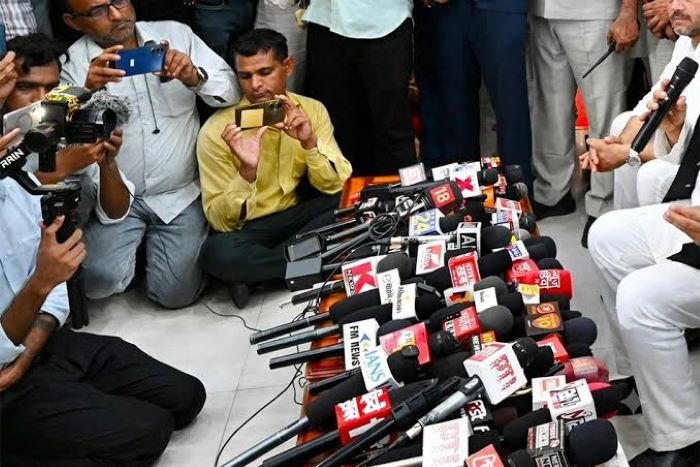
The two journalists, Ms. Shaheen Khan and Ms. Nafisa, representing 4 PM News Network, were allegedly assaulted by Delhi Police at the Saket police station. They had gone to Saket to cover an event attended by Delhi Chief Minister Rekha Gupta and Union Home Minister Amit Shah.
During the interaction, Shaheen Khan asked the Delhi chief minister about the alleged “cycle scam” in the national capital. The term “cycle scam” refers to alleged corruption in the procurement of free bicycles for schoolgirls in Delhi, where the BJP-led Delhi government has been accused of financial irregularities.
The question reportedly triggered a commotion. The two journalists were allegedly dragged out of the venue by women police officers stationed there and taken to a nearby police station, where they claim they were physically assaulted.
Also Read: War On Journalism
The journalists have alleged that the abuse worsened after the policewomen learned that they were Muslims.
Delhi Police denied the assault allegations and stated that the journalists were removed from the event following an argument over illegal parking and were taken to the police station for questioning.
The allegations have come amid growing criticism on social media over the reported police action and concerns about the treatment of protesters at the Jantar Mantar site in Delhi.
That incident has caused widespread public anger and protests by students and activists across the country. Young protesters are demanding accountability and an independent investigation into the Jantar Mantar incident. Now, a similar incident has allegedly taken place at the Saket police station. So far, no FIR has reportedly been registered against the police officers accused of wrongdoing, and public anger continues to grow.
Also Read: Reflections After 38 Years: Will the Twain (Social Sector and Media) Meet?
On September 3, Trinamool Congress MP Mahua Moitra, in a post, strongly criticized Delhi Police over the alleged treatment of the two young journalists. She alleged that the journalists were abused and assaulted while questioning the government’s alleged impropriety and said those responsible should not escape accountability.
Such incidents are not new. Muslim journalists in India have repeatedly faced allegations of targeted state action, legal harassment, and physical intimidation.
Mohammed Zubair, co-founder of Alt News, a prominent fact-checking website, was arrested by Delhi Police over a 2018 social media post. His work has frequently exposed hate speech by Hindu nationalist groups. International press freedom organizations condemned his arrest, viewing it as an attempt to penalize his journalistic work.
Also Read: Monday Musings: An Epitaph to Journalism
Siddique Kappan, a journalist who reported for Malayalam-language portals, was arrested by Uttar Pradesh Police under stringent anti-terror and sedition laws while traveling to cover the Hathras sexual assault case. He spent more than two years in detention before receiving bail.
Two Kashmiri journalists, Asif Sultan and Sajad Gul, have repeatedly been booked under stringent laws, including the Unlawful Activities (Prevention) Act (UAPA) and the Public Safety Act (PSA), following critical reporting or social media posts concerning security operations in Jammu and Kashmir.
Reporters covering events organized by Hindu nationalist groups have also reportedly been singled out, physically accosted, and forced to disclose their religious identities while carrying out their journalistic duties.
Also Read: Jews, Zionists and the media
The Caravan magazine photo editor Shahid Tantray was beaten by a Hindu mob while reporting on communal violence in Delhi in 2020. The attackers reportedly demanded his identity card and assaulted him after learning of his religious faith.
Multiple Muslim women journalists critical of government policies have also faced online harassment, with their photographs and personal information allegedly uploaded without consent onto fabricated online “auction” applications intended to degrade and silence them.
High-profile female Muslim journalists such as columnist Rana Ayyub and journalist Arfa Khanum Sherwani frequently face coordinated social media abuse, including online trolling, deepfakes, doxxing, and death threats.
Also Read: Grandpa Don’t Preach – Blood is on your sleeves
The bitter fact is that a large section of the mainstream media in India has consolidated behind the BJP and Hindutva forces. In such a situation, independent journalism has become an increasingly dangerous profession.
Among journalists, Muslims are arguably among the most vulnerable. They can become easy and conspicuous targets. According to an international report, Muslims constitute only 3 percent of journalists in Indian newsrooms. Mainstream media newsrooms remain disproportionately dominated by upper-caste groups, with Muslims severely underrepresented. An international study has examined the caste and religious composition of Indian newsrooms.
On a broader spectrum, Indian journalists face severe state repression through arbitrary arrests, digital censorship, physical assaults, and legal harassment under stringent laws.
Also Read: Politician and Sex crime is a new political culture in India
Section 152 of the Bharatiya Nyaya Sanhita (BNS) has been used to prosecute independent editors and critics. The government has also used the Information Technology (IT) Act to pressure technology platforms to restrict or remove critical news reports and social media posts. Reporters frequently face physical violence and beatings by police while covering street protests and public events.
Independent bodies such as the Press Club of India regularly protest such acts of violence and demand immediate action against abusive officials. However, since media professionals have increasingly become outcasts, no bell ever tolls for them.
India has slipped six places to rank 157th out of 180 countries in the 2026 World Press Freedom Index. Reporters Without Borders (RSF) has highlighted growing legal pressure on journalists, judicial harassment, and the increased use of national security laws to restrain journalists.
Also Read: Sanatan Sanstha’s activities are hurting Indian Muslims
It is a national shame that press freedom in India has fallen to its lowest level in the 25-year history of the index.
The India Observer — Fearless Journalism. Facts Matter.
Read the full story at TheIndiaObserver.com
Support independent journalism by sharing this article, commenting on the issue, and subscribing for future coverage.
Have a story, event, or issue to report?
Email your press release or tip to TheIndiaObserver@gmail.com— TIO covers news that matters. @AdamRizviTIO
Also Read more from this Author: Syed Ali Mujtaba invited to discuss ‘Safeguarding Children in India’s AI Future.’
Curated by Humra Kidwai