
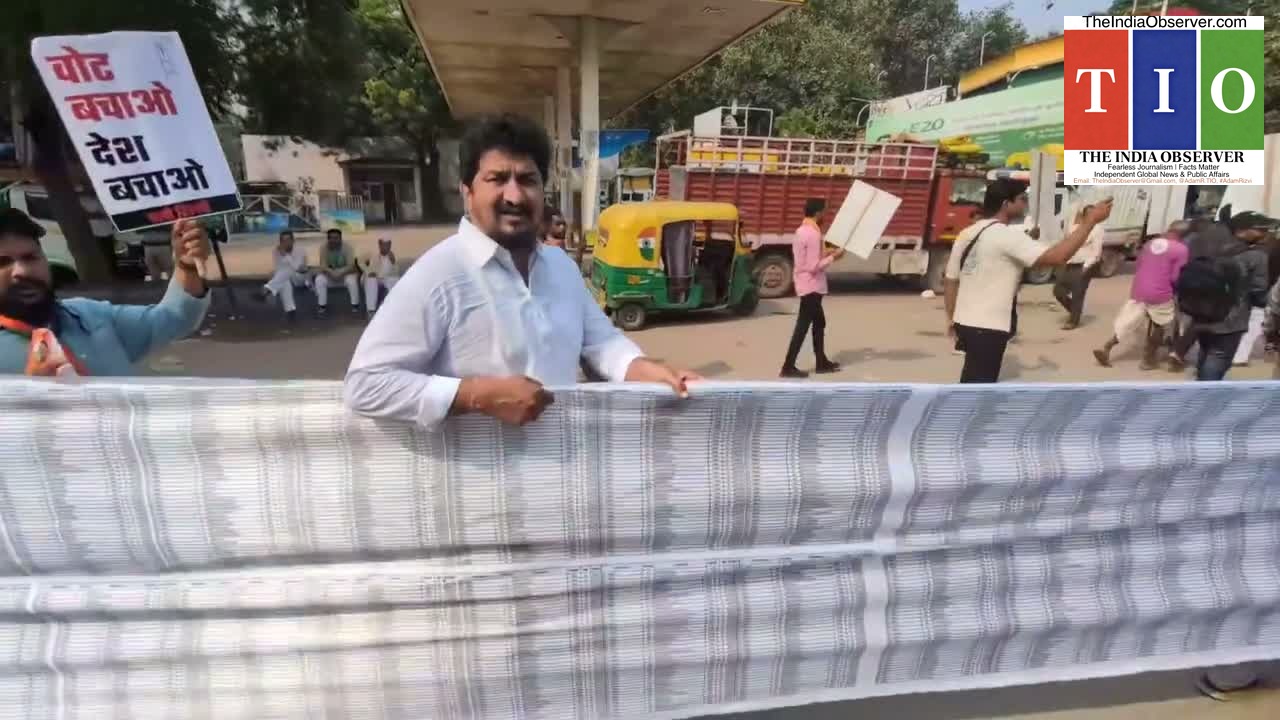
India’s Electoral Rolls Under Scrutiny as INDIA Bloc Displays Massive Voter-Name Banner at Delhi Protest
By Adam Rizvi | Editor, The India Observer (TIO)
NEW DELHI, November 1, 2026 — A striking visual emerged from the INDIA bloc’s protest at Delhi’s historic Ramlila Maidan on Sunday, where demonstrators displayed an enormous banner bearing names they alleged had been removed from India’s electoral rolls during the Election Commission’s Special Intensive Revision (SIR).
The banner, reportedly carrying approximately 90 lakh names, became one of the most prominent visual features of the demonstration, bringing renewed attention to the nationwide debate over electoral-roll revisions and the protection of citizens’ voting rights.
The protest, held under the slogan “Vote Bachao, Desh Bachao” (Save the Vote, Save the Country), brought together opposition leaders, party workers and supporters who questioned the manner in which the SIR exercise has been conducted.
Understanding the numbers behind SIR
The controversy centres partly on the scale of the electoral-roll revision.
Election Commission data reported in October indicated that approximately 13.39 crore entries had been flagged across three phases of the SIR exercise. These included approximately 6.30 crore entries classified as permanently shifted, 3.01 crore as absent or untraceable, 2.80 crore as deceased and 1.02 crore as duplicates.
However, these figures require careful interpretation. They represent entries identified during the revision process and should not automatically be interpreted as 13.39 crore eligible citizens being permanently deprived of their voting rights.
The Election Commission has maintained that the exercise is intended to remove deceased, duplicate and otherwise ineligible entries while ensuring that eligible voters remain on the rolls.
Concerns over wrongful exclusion
Opposition parties have argued that the process risks excluding genuine voters, particularly people who have migrated, economically disadvantaged citizens and individuals who may struggle to complete documentation or verification requirements.
An October 18 analysis by economist Surjit Bhalla estimated that approximately 70 lakh eligible voters may have been removed without adequate explanation in states where final electoral rolls had been published.
That figure is an independent estimate rather than an official determination. It nevertheless illustrates why the distinction between legitimate corrections and wrongful exclusions deserves serious examination.
The Election Commission has outlined procedures for verification, claims and objections, and appeals by voters whose names are missing from the rolls.
A question extending beyond party politics
The right to participate in elections is fundamental to representative democracy. Maintaining accurate electoral rolls is equally important, but the process must also be transparent, accessible and accountable.
The central question is not simply how many names have been removed. It is whether every eligible citizen has received a fair opportunity to remain registered, challenge an incorrect deletion and exercise the right to vote.
The enormous banner at Ramlila Maidan was intended by its organisers to make that question visible.
Ultimately, the credibility of an electoral process depends not only on removing ineligible entries but also on ensuring that no eligible voter is inadvertently or unjustifiably excluded.
Key facts
- What: INDIA bloc protest at Ramlila Maidan, Delhi, November 1, 2026, under the slogan “Vote Bachao, Desh Bachao” (Save the Vote, Save the Country).
- The visual: An enormous banner bearing names the demonstrators allege were removed from the electoral rolls — reportedly approximately 90 lakh names.
- The issue: The Election Commission’s Special Intensive Revision (SIR) of electoral rolls; about 13.39 crore entries flagged across three phases (6.30 crore permanently shifted, 3.01 crore absent/untraceable, 2.80 crore deceased, 1.02 crore duplicates).
- The caution: Flagged entries are not the same as eligible citizens disenfranchised. An independent estimate (economist Surjit Bhalla, October 18) put potentially unexplained removals at about 70 lakh in states where final rolls were published.
- The Election Commission’s position: The exercise removes deceased, duplicate and ineligible entries; procedures exist for verification, claims, objections and appeals.
Frequently asked questions
How many names were removed from the electoral rolls?
Election Commission data reported in October indicated approximately 13.39 crore entries were flagged across three phases of the SIR exercise. These are entries identified during revision — not a count of eligible citizens permanently deprived of voting rights.
What was the banner at the Delhi protest?
Demonstrators at Ramlila Maidan displayed an enormous banner bearing names they alleged had been removed from the rolls — reportedly approximately 90 lakh names.
What can a voter do if their name is missing?
The Election Commission has outlined procedures for verification, claims and objections, and appeals by voters whose names are missing from the rolls.
Watch: the voter-name banner at Ramlila Maidan
Video: Kajal Basu / Facebook. The footage shows the long banner of names carried through the protest at Ramlila Maidan, Delhi, on November 1, 2026.
Also Read
- Scrap Forms 6 & 7 — ‘SIR’ is a Fraud on Indian Democracy
- Hundreds of Indian Civil Society Leaders Accuse Election Commission of “Voter Suppression,” Demand Supreme Court Intervention
- The Battle For Bihar: Questions, Concerns & The Future Of India’s Democracy
Please read, comment, like and share — and subscribe to TheIndiaObserver.com if you haven’t yet. Thank you for supporting independent journalism. — Adam Rizvi, Editor-in-Chief, The India Observer | Fearless Journalism. Facts Matter.


