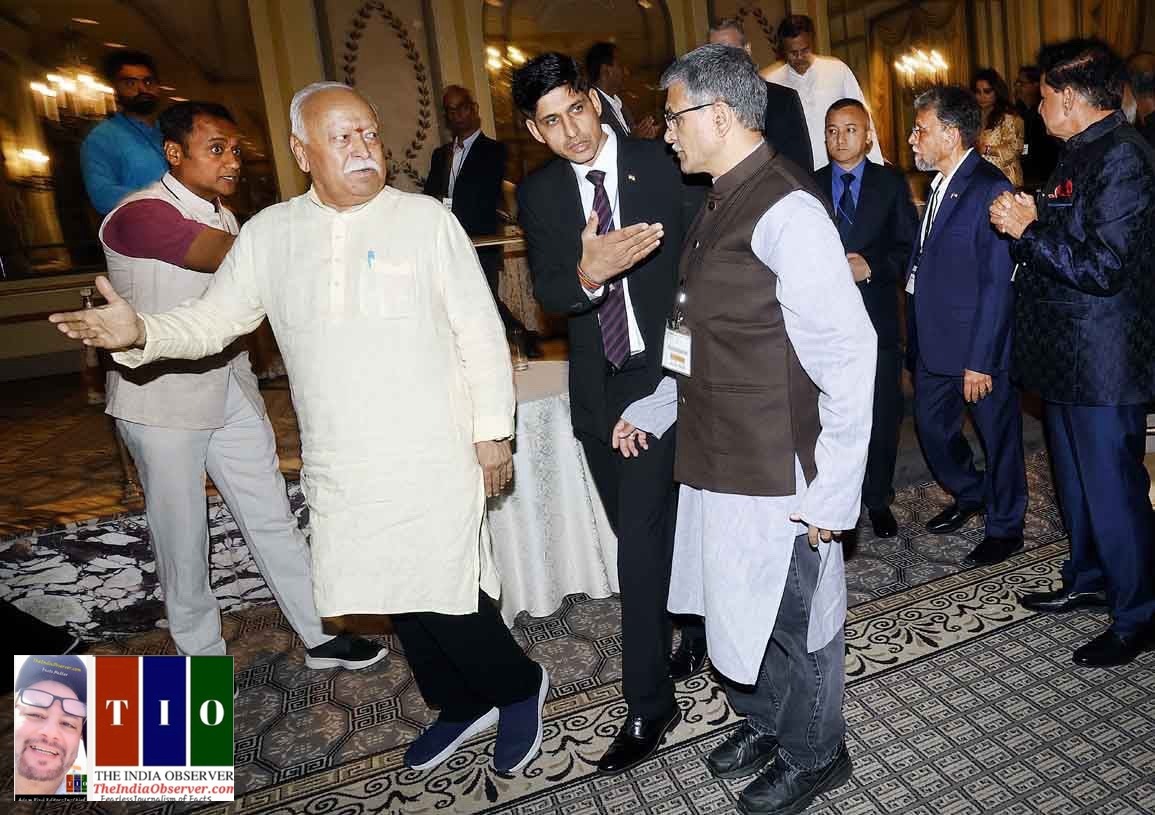
New York Challenges RSS Chief Mohan Bhagwat: Religious Freedom, Hindu Nationalism and the Question of Equal Citizenship
NEW YORK — New York is witnessing an unusually sharp confrontation over the meaning of religious freedom, Hindu nationalism and the political influence of India’s Rashtriya Swayamsevak Sangh (RSS).
On one side is RSS chief Mohan Bhagwat, appearing at Madison Square Garden for a “Universal Oneness Celebration,” an event organizers describe as an effort to promote unity, dialogue and shared heritage.
On the other is a coalition of Hindu, Muslim, Christian, interfaith and civil-rights organizations arguing that the RSS should not be allowed to present itself simply as a cultural or spiritual organization while critics continue to raise concerns about its political influence and the treatment of religious minorities in India.
The controversy has now entered New York’s political conversation. Mayor Zohran Mamdani has publicly opposed Bhagwat’s appearance, while acknowledging the limits of the city’s legal authority over a private event.
But there is an important distinction that should not be lost: Opposing an ideology is not the same as opposing a religion. The RSS does not represent all Hindus. Millions of Hindus do not belong to the organization. Indeed, some Hindu Americans are among those opposing Bhagwat’s appearance. That makes this controversy considerably more complicated than a simple Hindu-versus-Muslim dispute.
THE QUESTION ABOUT POLICE
One allegation circulating in political and social-media discussions deserves particularly careful treatment: that RSS members routinely join police forces in order to beat Muslims or others who oppose the BJP or Prime Minister Narendra Modi. There is not sufficient evidence to responsibly make that sweeping claim as a fact. That distinction matters. But neither should documented allegations of police misconduct and communal bias simply be dismissed. Human Rights Watch has documented police complicity and failures during the 2020 Delhi violence, including cases involving police abuse of injured Muslim men and failures to protect Muslims from attacks. There is also a separate development that deserves public scrutiny. In 2024, India’s central government removed a longstanding restriction on government employees participating in RSS activities. That change does not establish that India’s police force is an RSS organization. But it does raise legitimate questions about the relationship between political ideology, public institutions and the independence of government employees. The responsible journalistic question is therefore not: “Are all RSS members in the police beating Muslims?” There is no basis for such a blanket statement. The better question is: When political ideology becomes increasingly intertwined with state institutions, how does a democracy guarantee that its police remain politically and religiously neutral? That is a question worth asking in India—and anywhere else.
THIS IS BIGGER THAN MODI
It would be easy to make this entire controversy about Narendra Modi. That would miss the larger issue. The debate concerns the relationship between the RSS, the BJP and competing visions of Indian nationalism. The RSS describes itself as a cultural organization dedicated to national unity and social service. Critics—including human-rights organizations and members of India’s religious minorities—argue that Hindu nationalist politics has contributed to an environment in which minorities, particularly Muslims, face discrimination and insecurity. Both sides should be challenged. Critics must substantiate serious accusations with evidence. But defenders of the RSS should also understand that criticism of the organization is not automatically hatred of Hinduism. Hinduism and the RSS are not synonymous. Nor should every Hindu be expected to defend an organization simply because it identifies itself with Hindu civilization.
NEW YORK HAS A RIGHT TO ASK QUESTIONS
America’s First Amendment protects freedom of speech and religion. That protection applies even when the speaker or organization is controversial. Therefore, the answer to controversial ideology should not automatically be censorship. It should be more speech, more journalism, more scrutiny and more accountability. If Bhagwat speaks about universal brotherhood, equality and harmony, those principles should be welcomed. But they should also be examined against the record and political influence of the organization he leads. And if critics accuse the RSS of majoritarianism, they should be prepared to substantiate those accusations. This is precisely where journalism must stand between political camps.
NOT HINDUS VS. MUSLIMS
The most misleading way to frame this controversy would be: Hindus versus Muslims. It is not that simple. There are Hindus who support the RSS. There are Hindus who oppose it. There are Muslims who oppose it. There are Muslims who may have no interest in the controversy whatsoever. There are Christians, Sikhs, Jews, secular Americans and others who have legitimate views about the role of religious nationalism in democratic societies. That diversity should be respected. Criticism of the RSS is not criticism of Hinduism. And defending Hinduism does not require defending the RSS.
THE INDIA OBSERVER’S POSITION
TIO believes every community has the right to organize, speak, worship and participate in American public life. But no religious or political movement should receive immunity from scrutiny because it invokes religion, culture or heritage. We will defend the rights of Hindus. We will defend the rights of Muslims. We will defend Christians, Sikhs, Jews, atheists and everyone else. And we will oppose majoritarianism—whether it comes wrapped in religious nationalism, ethnic nationalism or any other political ideology. New York is not India. America is not a Hindu state, Muslim state, Christian state or Jewish state. It is a constitutional democracy in which government belongs equally to the believer and the non-believer, the majority and the minority, the powerful and the powerless. That is why this debate matters. The question is not whether Mohan Bhagwat has the right to speak in New York. He does. The question is whether New Yorkers have the right to question what he represents. They do too. Fearless Journalism. Facts Matter.
EDITOR’S NOTE
The India Observer distinguishes between Hinduism as a faith practiced by millions of people and the political or organizational ideology of the RSS. Serious allegations should be supported by evidence, and criticism of a political organization should never be equated with hostility toward an entire religious community.