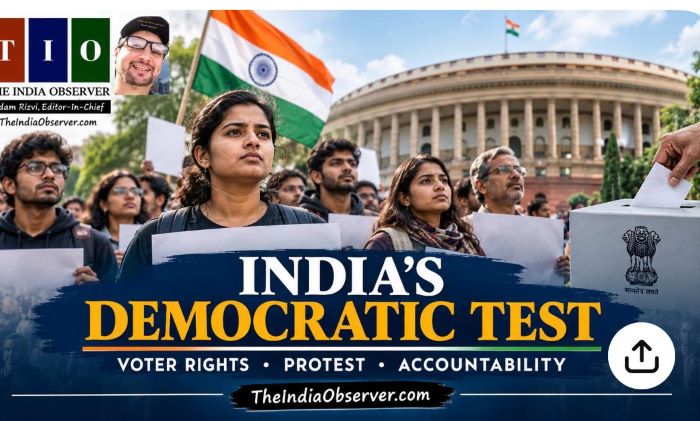
India’s Vote, Its Streets and a Democracy Under Pressure: Who Will Hold Power Accountable?
Share, Comment, Like, and Subscribe to support Independent Journalism!
By Adam Rizvi | Editor, The India Observer, TIO: India calls itself the world’s largest democracy. But democracy is measured by more than the number of people who vote or the frequency with which elections are held. It is also measured by whether eligible citizens can exercise their right to vote, whether election authorities can explain their decisions, whether courts can provide meaningful remedies, and whether citizens can challenge those in power without being subjected to intimidation or excessive force.
Recent protests across India have brought these questions into sharp focus.
The controversy surrounding the Election Commission of India’s Special Intensive Revision (SIR) of electoral rolls has grown into a national confrontation over voting rights, institutional accountability and the treatment of political dissent.
Also Read: Scrap Forms 6&7 – ‘SIR’ is a Fraud on Indian Democracy
The protests have drawn opposition leaders, student activists and young people who fear that the revision process could deprive eligible citizens of their democratic rights.
The Modi government and the Bharatiya Janata Party (BJP) reject allegations that the process is politically motivated. The Election Commission has defended its work as an exercise to improve electoral rolls. Those explanations deserve to be examined alongside the evidence, not accepted or rejected simply because of the political identity of those making the claims.
An investigation published by The Reporters’ Collective on October 9 reported that Election Commission software automatically generated 85,854 Form 7 requests to delete voters in Uttar Pradesh without specifying a reason. The outlet said the forms carried the digital signatures of election officers and were generated during the SIR process.
Also Read: The Future of the Cockroach Janata Party’s Protests
Hundreds of Indian Civil Society Leaders Accuse
In a follow-up report published on October 14, the investigative outlet said Uttar Pradesh Chief Electoral Officer Navdeep Rinwa disputed its findings but confirmed that the software had generated the forms. The outlet maintained that the forms did not provide the reasons required under applicable procedures.
These are serious allegations about the administration of electoral rolls. They warrant clear answers from the Election Commission.
Why were so many forms generated without specific reasons? What checks were applied before voters could be removed? Were the affected citizens notified and given a meaningful opportunity to challenge their exclusion? Who bears responsibility when software and administrative procedures produce decisions that may affect a citizen’s fundamental democratic rights?
The Election Commission should publish a transparent explanation, including the legal basis for the process, the number of affected voters, the safeguards applied and the outcomes of subsequent appeals.
The issue is not whether voter lists should be cleaned up. Accurate electoral rolls are essential to credible elections. The issue is whether that work is conducted lawfully, transparently and without depriving eligible citizens of their right to vote.
The scale of the controversy is also significant. Reuters reported on October 12 that more than 130 million names had been removed from electoral rolls through the revision process. The reported categories included deceased voters, people who had relocated and people who could not be traced.
Also Read: Bihar Election – How elections are rigged in India through democratic fraud!
The government and election authorities have defended the exercise as necessary to improve electoral accuracy. Critics, however, question whether the process has wrongly excluded large numbers of living, eligible citizens, including people from vulnerable communities.
A name removed from a voter list is not simply an administrative statistic. It can mean that a citizen who has participated in elections for decades suddenly finds that the right to vote is in question.
The consequences can be particularly serious for people who lack easy access to official documents, legal assistance or the time and resources needed to navigate an appeals process.
Also Read: What Election Results Mean; An Example From My Files
The burden should not fall disproportionately on ordinary citizens to prove their eligibility after an administrative system has raised doubts about them. There must be an accessible, timely and transparent process for correcting mistakes.
The government has a legitimate interest in preventing duplicate and fraudulent registrations. Citizens have an equally legitimate interest in ensuring that genuine voters are not wrongly excluded. Both objectives must be protected.
The response to the protests has raised another set of concerns.
Also Read: The Battle For Bihar: Questions, Concerns & The Future Of India’s Democracy
On October 13, Human Rights Watch called on Indian authorities to end what it described as a crackdown involving excessive force, arbitrary detentions and restrictions on peaceful demonstrations. The organization reported that protesters had been beaten, forcibly dragged and taken away in vehicles, while journalists covering the demonstrations had also faced detention and harassment.
These are grave allegations. They require investigation, and the authorities should release relevant records and footage so that individual incidents can be examined.
Also Read: High-Level Committee on Demographic Changes is a threat to India
The right to peaceful assembly does not disappear because a demonstration embarrasses the government or challenges an influential public official. Police have a responsibility to maintain public order and protect people from violence. That responsibility does not provide unlimited authority to use force against demonstrators.
Where protesters commit violence, the evidence should be investigated and individuals held accountable under the law. Where police use excessive or unlawful force, the same principle must apply.
There should be no double standard.
Also Read: Hundreds of Indian Civil Society Leaders Accuse
Questions have also been raised about the identity and authority of individuals seen participating in the enforcement of restrictions or using force against demonstrators. Any specific allegation that people who are not serving police officers were supplied with police uniforms or authorized to assault protesters must be independently verified. Authorities should clarify who was deployed, under whose command, and with what legal authority.
Uniforms, badges and official powers must never become instruments for intimidation by people who have no lawful authority to exercise them.
The protests have also brought a younger generation of activists into national attention.
Also Read: Media Professionals Have No Dignity Left in India
Neha Bora, president of the All India Students’ Association (AISA), has spoken out against the treatment of demonstrators. News reports described her detention during protests and her allegations about cramped detention buses and the treatment of protesters.
Abhijeet Dipke, founder of the youth-led Cockroach Janta Party, has also become a prominent figure in the campaign demanding accountability from the Election Commission.
Reuters reported on October 17 that Dipke was released by a court a day after being detained in connection with an attempted protest demanding the resignation of Chief Election Commissioner Gyanesh Kumar. Neha Bora was also reported to have been released.
Also Read: Electronic Voting Machines and India’s Quest for Free and Fair Elections
Their political positions and methods can be debated. Their rights to peaceful expression and due process cannot simply be dismissed because their demands are inconvenient to those in power.
Young citizens who question institutions are not necessarily enemies of the nation. In a democracy, dissent can be a warning that institutions need to explain themselves, correct mistakes and regain public trust.
The proper response is to address substantiated concerns, not to make an example of those who raise them.
Congress leader and Leader of the Opposition Rahul Gandhi has joined the challenge to the voter-revision process. Reuters reported that opposition leaders, including Gandhi, participated in a march to the Supreme Court seeking an audit of voter deletions, safeguards against arbitrary removal and suspension of the revision process.
Also Read: “Vote Theft” allegation needs an Independent Investigation
The opposition has described the controversy in terms of “vote theft,” arguing that the process risks weakening electoral democracy. The BJP has rejected those accusations and accused its opponents of trying to discredit legitimate elections.
Political rhetoric, however forceful, is not a substitute for evidence. The opposition must substantiate its allegations and present its case through lawful democratic and judicial processes.
At the same time, the government cannot treat every challenge to its conduct as an attempt to undermine the country. An opposition party has a constitutional role in scrutinizing those who govern, and citizens have the right to demand explanations from public institutions.
Also Read: Mapping Muslim Assembly Constituencies in Bihar
Rahul Gandhi and other opposition leaders should press for independently verifiable answers, transparent data, accessible appeals and accountability for any unlawful conduct established by the evidence.
The objective should be to protect every eligible voter, not merely to secure a political advantage for one party over another.
The Election Commission occupies a position of enormous public responsibility. Its decisions can determine whether citizens are able to participate in elections and whether political competition is conducted fairly.
That is why allegations of irregularities in the voter-revision process cannot be dismissed as an ordinary dispute between the government and the opposition.
The Commission should disclose its procedures, explain the software-generated forms, publish reliable figures on challenged and restored registrations, and demonstrate that voters have effective remedies when mistakes occur.
Also Read: Ostracism Of Indian Muslims
The judiciary also has a critical role. Petitions challenging the revision process and seeking action concerning the chief election commissioner have brought the courts into the debate. The courts must consider the evidence and apply the law independently.
There are wider political allegations that election authorities and judicial institutions have become too closely aligned with the ruling establishment. Those allegations must be assessed on specific evidence. Claims that judges were controlled or rewarded with parliamentary positions should not be presented as established fact without documented support.
Institutional independence is too important to be defended through speculation. It must be demonstrated through transparent decisions, reasoned judgments and equal application of the law.
Also Read: Championing Freedom: Embracing the Call to Defend Democracy
Some protesters and political critics have used language describing Prime Minister Narendra Modi as illegitimate, arguing that electoral irregularities have undermined the legitimacy of his government.
That is a political allegation, not an established legal conclusion.
Serious questions about voter registration, electoral procedures or institutional independence do not, by themselves, establish that a prime minister legally holds office without authority. Any claim that an election was invalid or that the government lacks legal legitimacy requires evidence and the appropriate legal determination.
Also Read: Death of Democracy and Birth of Autocratic ‘Demoncracy’ in India
But the absence of such a determination does not make every concern about electoral integrity irrelevant.
A government can possess legal authority while still facing legitimate demands for greater transparency and accountability. The responsibility of the Election Commission is to ensure that eligible citizens can vote. The responsibility of the government is to protect democratic rights. The responsibility of the opposition is to scrutinize power and provide evidence for its claims.
No institution should be beyond examination.
India has a proud democratic tradition, a diverse population and a Constitution that promises equality and political participation. Those achievements should not be taken for granted, nor should they be used to shield institutions from criticism.
Also Read: Education is the key to the development of Muslims in India
The current controversy presents a straightforward test.
Can the Election Commission explain how voter-deletion decisions were generated and ensure that eligible citizens are not wrongly removed? Can the police maintain public order without violating the rights of peaceful demonstrators? Can the courts provide effective remedies? Can the government answer serious questions without treating criticism as hostility toward the nation?
These questions matter regardless of which party benefits electorally.
If the process is lawful, transparent evidence should help establish that. If mistakes or violations occurred, they must be corrected and those responsible held accountable. If citizens were wrongly deprived of their voting rights, their cases should be resolved without unnecessary delay.
Also Read: Social Media Spreading Canard against Muslims in India
The government must not fear scrutiny. The opposition must not substitute allegations for proof. The police must not act above the law. The Election Commission must not expect unquestioning trust. And the courts must remain open to genuine legal challenges.
Democracy is not measured by how comfortably a government exercises power. It is measured by how effectively the people can hold that government accountable.
That is the standard India must meet.
Source note: This analysis draws on reporting by The Reporters’ Collective, Reuters and Human Rights Watch. Allegations attributed to those sources are identified as such; they are not presented as judicial findings.
Also Read: “Indian Muslims’ Tryst with Democracy”
The India Observer — Fearless Journalism. Facts Matter.
Read the full story at TheIndiaObserver.com
Support independent journalism by sharing this article, commenting on the issue, and subscribing for future coverage.
Have a story, event, or issue to report?
Email your press release or tip to TheIndiaObserver@gmail.com— TIO covers news that matters. @AdamRizviTIO
Curated by Humra Rizvi