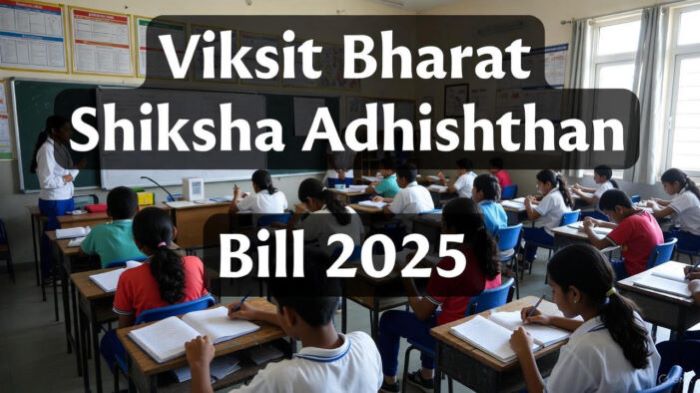
VIKSIT BHARAT SHIKSHA ADHISHTHAN (VBSA) Bill, 2025 is not in national intrest
Share, Comment, Like, and Subscribe to support Independent Journalism!
By Syed Ali Mujtaba, Edited by Adam Rizvi, The India Observer, TIO: The referral of the VBSA Bill, 2025 to a Joint Parliamentary Committee (JPC) is not a routine legislative step—it is itself constitutionally questionable. A JPC cannot deliberate upon a Bill whose subject matter lies outside the legislative competence of Parliament. Under the Constitution of India, Parliament has no authority to legislate on subjects enumerated in List II (State List) of the Seventh Schedule.
The regulation and incorporation of universities fall squarely within the constitutional domain of the States. Parliament’s role in education is limited and clearly defined: coordination and determination of standards in higher education. Any attempt to go beyond this mandate amounts to a direct encroachment upon the federal structure of the Constitution.
Also Read, Tweet & Share: Waqf Bill attack on India’s constitutional fabric: Pramod Tiwari, MP
Education—both primary and higher—requires sustained care, nurturing, and public investment. It is a responsibility that governments cannot abdicate without inflicting lasting harm on society. The withdrawal of the State from education is not reform; it is abandonment.
The timing of this Bill is particularly telling. January 3 marks the birth anniversary of Savitribai Phule, and January 9 that of Fatima Sheikh—two pioneering educators who worked together to open the doors of learning to the bahujan, especially girls, at a time when education was fiercely guarded by caste and patriarchy. Their legacy reminds us that education is not a commodity but a tool of liberation.
Also Read, Tweet & Share: Waqf Amendment bill- A Hidden Agenda to further ‘Pulverize’ Indian Muslims
Jyotiba Phule’s warning remains as relevant today as it was in the nineteenth century:
“Without education, wisdom is lost.
Without wisdom, morals are lost.
Without morals, progress is lost.
Without progress, wealth is lost.
Without wealth, the oppressed are ruined.
So many disasters caused by a single lack of education.”
Read in this light, the VBSA Bill, 2025 represents a systematic denial of education to the bahujan. By facilitating the withdrawal of government funding and opening education to unrestricted private and foreign participation, the Bill accelerates the transformation of education into a profit-driven market.
If enacted, State Governments will lose their authority to regulate educational institutions within their jurisdictions. Education will cease to be a public good and will instead become a commercial service governed by the ability to pay. Government-funded higher education institutions will gradually be replaced by fully self-financed institutions, forcing students to negotiate their futures in an unforgiving marketplace.
Also Read, Tweet & Share: Waqf Amendment Bill- Attempt to Snuff the Soul of Indian Muslims
The Bill also envisages unprecedented centralisation. Every university, every faculty member, every researcher, and every student will function under the direct surveillance of the Union Government. Such a framework strikes at the heart of academic freedom.
Once passed and assented to by the President, the Bill would effectively operationalise the authoritarian maxim:
“All within the state, nothing outside the state, nothing against the state.”
Academic autonomy will be reduced to a fiction. The intellectual life of universities will be governed not by inquiry or debate, but by compliance and control.
Also Read, Tweet & Share: Food Safety and Standards (Amendment) Act, 2025 assault on India’s Halal economy
Parliamentarians must confront the constitutional reality. Parliament has no power to incorporate or regulate universities. A combined reading of Entry 44 of List I, Entry 32 of List II, and Entry 25 of List III of the Seventh Schedule makes it clear that the Union Government’s authority is limited to coordination and standards—not domination.
The people of India, the ultimate sovereign, have entrusted Parliament with the responsibility of safeguarding the Constitution—an instrument shaped by the freedom movement and grounded in federalism, democracy, and social justice. Any attempt to undermine this balance is a betrayal of that trust.
Also Read, Tweet & Share: SC Judgment on Waqf Act is a Case of Match Fixing
Therefore, the VBSA Bill, 2025—being outside Parliament’s legislative competence—should not be taken up for discussion at all.
To deliberate upon this Bill in either House of Parliament, or in a Joint Parliamentary Committee, is in itself an assault on the Constitution of India.
Also Read more from this Author: Book Release: Author Mujtaba Syed calls for Democratic response to the Challenges faced by the Muslim Community
Curated by Humra Kidwai
Articles written by contributors have different viewpoints. The views expressed in the articles are the author’s own and not necessarily supported by TIO, The India Observer its affiliates, staff, or the management. Our Articles can be reproduced, with the following conditions, (1) No alteration to the content, (2) Visible, and full credit is given to the Author & Editor. (3) Citing, The India Observer, TIO. In the case of online or electronic media, a link to the original article must be given. Rules are strictly enforced. Any questions, email the Editor at: Mediaiss@gmail.com Or TheIndiaObserver@gmail.com