
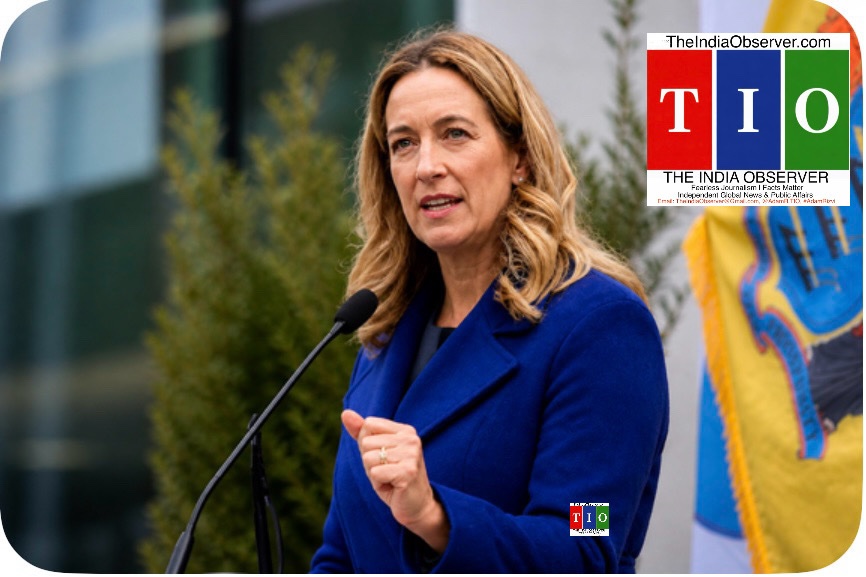
Sherrill Warns NJ Port Operators Against Accepting Russian Diesel, Citing Federal Law
TRENTON, NJ — November 3, 2026
By Adam Rizvi | Editor, The India Observer (TIO)
New Jersey Governor Mikie Sherrill has warned port and terminal operators across the state against accepting Russian-origin diesel shipments, arguing that importing the fuel violates federal law and could expose businesses and individuals to substantial civil and criminal penalties.
In a letter dated November 2 and addressed to New Jersey port and terminal operators, Sherrill said businesses involved in purchasing, unloading or facilitating the importation of Russian fuel could face serious legal consequences.
Key facts
- Who: Governor Mikie Sherrill, in a letter to New Jersey port and terminal operators, November 2, 2026
- What: Notice that buying or unloading Russian diesel likely violates federal law
- Law cited: Ending Importation of Russian Oil Act (2022); OFAC General License No. 135 (October 9, 2026)
- Penalty cited: up to the full value of the shipment; five-year limit
- Why now: tankers reported bound for the East Coast; at least one may be headed for the New Jersey coast
The warning follows the Trump administration’s authorization of certain Russian diesel transactions through the U.S. Department of the Treasury’s Office of Foreign Assets Control (OFAC). The agency issued General License No. 135 on October 9, authorizing transactions related to the sale, delivery, offloading and importation of Russian-origin diesel fuel, including imports into the United States.
Sherrill maintains that the federal authorization conflicts with legislation enacted by Congress in 2022 following Russia’s invasion of Ukraine.
Governor cites 2022 federal legislation
The Governor’s letter references the Ending Importation of Russian Oil Act, signed into law on April 8, 2022. The legislation prohibits the importation of Russian energy products classified under Chapter 27 of the Harmonized Tariff Schedule of the United States, which includes diesel fuel.
Sherrill argues that the President and Treasury Department cannot simply override the congressional prohibition through an administrative license.
The law provides a specific process for terminating the import ban, requiring presidential certification of conditions concerning Russia’s withdrawal from Ukraine, the cessation of hostilities under terms accepted by Ukraine, and other security-related requirements.
The Governor maintains that those statutory requirements have not been satisfied.
Dispute over Treasury authorization
A central issue in the dispute is whether OFAC’s General License No. 135 can legally authorize transactions that appear to fall under the import prohibition enacted by Congress.
Sherrill also argues that the authorization constitutes a significant change in U.S. foreign policy toward Russia and therefore triggers congressional reporting and review requirements under federal law.
The legal applicability of those provisions to the Treasury license remains an important question in the dispute.
Governor Sherrill said, in her letter: “New Jersey will not stand by while Donald Trump supports Vladimir Putin at the expense of Americans. Instead of lowering costs, he is helping finance Putin’s war against Ukraine and a global campaign of violence and terror that endangers U.S. servicemembers abroad. As a Navy veteran, I cannot let that stand unchallenged, and New Jersey’s ports shouldn’t be complicit. Every port and terminal operator, intermediary, and buyer is on notice: do not help bring illegal Russian diesel into New Jersey.”
Potential financial penalties for businesses
The Governor’s letter also points to Section 1595a(b) of Title 19 of the U.S. Code, which provides for penalties against individuals or businesses involved in unlawful importation. The provision allows a penalty equal to the value of the goods introduced or attempted to be introduced into the country.
Sherrill cautioned port operators and other businesses that potential liability could extend beyond the current administration.
She urged operators to turn away tankers seeking to use their facilities for activities she considers unlawful.
Ukraine, Iran and national security concerns
In explaining her opposition, Sherrill argued that Russian oil revenue helps finance Moscow’s continuing war against Ukraine.
She also raised national security concerns involving Russia’s relationship with Iran and the ongoing U.S.-Iran conflict.
The Governor, a former U.S. Navy helicopter pilot, said she could not allow New Jersey’s ports to become involved in activities that she believes undermine American interests or support countries hostile to the United States.
Her letter concluded with a pledge to use every available legal and regulatory tool to prevent New Jersey’s ports, businesses and infrastructure from facilitating the trade.
The dispute places New Jersey’s port operators at the intersection of federal energy policy, international sanctions and a broader disagreement over the limits of executive authority.
The Governor’s Office release did not include a response from the Trump Administration or the Treasury Department.
Frequently asked questions
- What did Governor Sherrill do? She sent a November 2 letter putting New Jersey port and terminal operators on notice that importing Russian diesel likely violates federal law.
- Why does she say it is illegal? Congress’s 2022 Ending Importation of Russian Oil Act bans Russian Chapter 27 products, including diesel; the Act can only be lifted by a presidential certification that Russia has agreed to withdraw from Ukraine — no such certification has been made.
- What is General License No. 135? A U.S. Treasury OFAC license issued October 9, 2026, purporting to authorize transactions related to the sale, delivery, offloading or importation of Russian-origin diesel fuel.
- What penalties could operators face? Civil and criminal consequences; under 19 U.S.C. § 1595a(b), a penalty equal to the value of the goods introduced or attempted to be introduced, with a five-year statute of limitations.
- What happens next? Sherrill has pledged to use every available legal and regulatory tool to keep New Jersey’s ports from facilitating the trade.
Source: Governor’s Office, State of New Jersey.


