It’s ‘Domicide’, not Bulldozer Demolition
Share, Comment, Like, and Subscribe to support Independent Journalism!
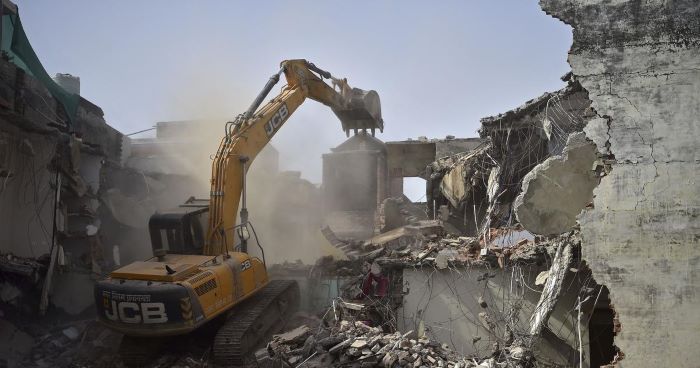
By Syed Ali Mujtaba, Edited by Adam Rizvi | Editor, The India Observer (TIO): Two brazen patterns are emerging against the Muslims of India; one is trimming their electoral strength through Special Intensive Revision (SIR). This is to emasculate their electoral strength so that they can never be part of any democratically elected bodies in their motherland, and the second is the bulldozer demolition, which is a punitive action in case they protest the injustices happening against them.
A report by Housing and Land Rights Network has revealed that state governments, through forced evictions, demolished 46,371 houses in 2022. This figure doubled to 1,07,449 demolished houses in 2023.
The figures after that are not available, but as this trend is on the rise, the figures in subsequent years must have increased.
Muslims may lose huge Waqf property after Special Intensive Revision
An Amnesty International Report has also documented how demolitions of the houses are being used as a way of inflicting suffering on Muslims and other dissidents in India.
While the word Demolition is caught in semantics, the word ‘Domicide’ means the killing of a home, which carries the promise of safety, a necessity for dignity of life. Home, therefore, is a living entity so it can never be demolished, and any such attempt to do so should be ‘domicide.’ Just like genocide means killing a people and suicide means killing oneself, ‘domicide’ means killing one’s homes.
The word ‘domicide’ is coined by J Douglas Porteous and Sandra E Smith, which is made up of two Latin words — domus (home) and caedere (to kill). Porteous and Smith define ‘domicide’ as the deliberate destruction of the home that causes surmountable suffering to its inhabitants.
Growing Hate Crime against Muslims continues under Modi 3.0 rule
Since the architecture of the home is inseparable from the life it shelters, ‘domicide’ is not just the destruction of an architectural object but also the displacement of life and infliction of suffering. ‘Domicide’ kills not only the home but its all-encompassing meaning that has multidimensional characteristics.
The most important part of ‘domicide’ is that it is characterised by a power differential between the political interests of the ruling class and some of the most marginalised sections of society that aspire to live in peace and harmony.
In the case of India, we are seeing this novel form of ‘domicide’ where governments of the day have used it against Muslims as a form of punishment, giving rise to the phenomenon of bulldozer politics in India.
Fahad Zuberi, an Indian scholar whose work focuses on the intersection of architecture and violence, particularly in India, in his research calls this punitive action of the destruction of Muslim homes executed as punishment by the government ‘domicide’.
Indian Media’s project to separate Hindus from Muslims is on the wane
Many elected politicians, mostly from the BJP, in their rallies have advocated the use of a bulldozer to demolish Muslim homes in an attempt to show the superiority of Hindus over Muslims.
In November 2024, the Supreme Court of India issued a ruling banning “bulldozer justice,” declaring that the executive cannot demolish properties merely because the owner is an accused or convicted criminal. The Court held that such actions are unconstitutional, violate the right to shelter, and establish a “lawless, ruthless state of affairs”.
This judgment has hardly stopped any such punitive action from taking place against the Muslims in India. There are umpteen cases of punitive ‘domicide’ — Jahangirpuri, Prayagraj, Kargone, Nuh, etc. that show a similar pattern. The phenomenon is marked by a provocative event, followed by a response and protest, police action, a political narrative of “bulldozing the houses of the rioters”, and the execution of ‘domicide’ by the local development authority using municipality acts and other development norms.
“Indian Muslims’ Tryst with Democracy”
Slum clearances are also routine in contemporary Indian cities, especially ahead of major events. Delhi saw a massive ‘domicide’ before the 2010 Commonwealth Games and before the G20 summit in 2025.
This is to drive the point that the word “demolition” is simply not enough to explain the deep wound that is inflicted on the poor Muslims through bulldozer demolition of their homes. The word ‘domicide’ could be the right expression to express their sufferings.
We should depart from the language that camouflages and recognizes the destruction of homes as a form of violence on its inhabitants. We should evolve our own vocabulary to understand such a pattern of violence evolving in India.
An appeal, therefore, goes to the Indian media and intelligentsia to use the word “domicide” instead of bulldozer demolition. The usage of the word “domicide” can only comprehensively represent the act of destroying someone’s home, which is the most heinous crime in a democratic country like India.
Also Read more from this Author: ‘We are Living in a mediatized Society,’ says noted journalist Syed Ali Mujtaba
Curated by Humra Kidwai