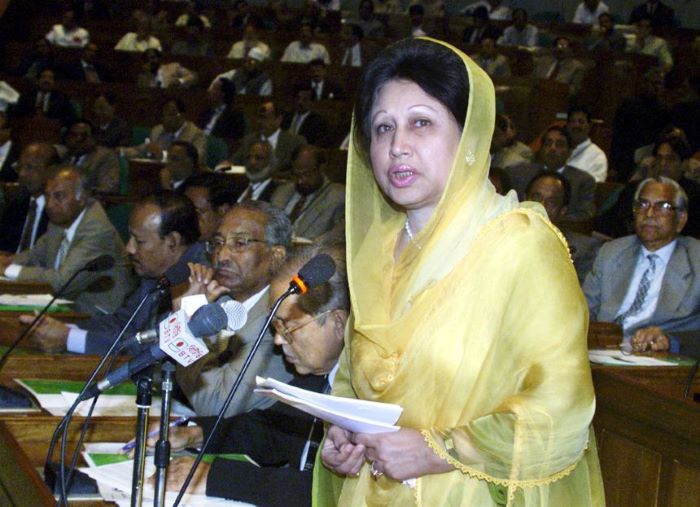
Dhaka khaleda Zia Dead
Share, Comment, Like, and Subscribe to support Independent Journalism!
By Adam Rizvi, Editor, The India Observer (TIO): Dhaka: Khaleda Zia, Bangladesh’s first woman prime minister and longtime chairperson of the Bangladesh Nationalist Party (BNP), passed away on Tuesday after a prolonged illness. She was 80, the party confirmed.
According to her doctors, Khaleda Zia had been suffering from multiple serious health conditions, including advanced cirrhosis of the liver, diabetes, arthritis, and chronic heart and chest complications. She had been receiving treatment at a Dhaka hospital since November 23 and was placed on ventilator support on December 11 as her condition worsened.
Zia served as Bangladesh’s prime minister for three terms — from 1991 to 1996, briefly in 1996, and again from 2001 to 2006 — becoming one of the most influential and polarizing figures in the country’s political history. She was married to former President Ziaur Rahman, a military officer who broke ranks with the Pakistan Army during Bangladesh’s liberation struggle and was assassinated in a 1981 coup.
Also Read, Tweet & Share: Is he Dhaka’s Manmohan Singh?
Her death comes at a politically sensitive time for Bangladesh. Just days earlier, her son and BNP’s acting chairperson, Tarique Rahman, returned to the country after 17 years in exile. Rahman is widely seen as a leading contender for the prime minister’s post ahead of the upcoming general elections scheduled for February.
On Monday, nomination papers were submitted on behalf of Khaleda Zia for the Bogura-7 constituency — considered her political stronghold — while Tarique Rahman filed to contest from Dhaka-17 and Bogura-6, according to Indian media reports. Khaleda Zia had previously won the Bogura seat in the 1991 general election and retained it in 1996 and 2001.
Also Read, Tweet & Share: Bangladesh: Images Like Dry Flower From My Notebook
Her later political career, however, was overshadowed by legal battles and corruption convictions. In 2018, she and several others, including Tarique Rahman, were convicted in the Zia Orphanage Trust case involving the alleged embezzlement of 21 million taka in foreign donations. Later that year, she was sentenced to seven years’ imprisonment in a separate case linked to the Zia Charitable Trust. Both sentences were ordered to run concurrently.
Prosecutors had alleged that the trusts, named after her late husband, existed largely on paper. Due to deteriorating health, Zia was released from prison in 2020. Her family subsequently sought permission multiple times for her to travel abroad for treatment, but requests were denied under the government of her political rival, former Prime Minister Sheikh Hasina.
Following the ouster of Hasina in August 2024 after weeks of student-led protests, Nobel laureate Muhammad Yunus assumed charge as chief adviser of Bangladesh’s interim government. The interim administration allowed Zia to travel to London for treatment, after which she returned to Bangladesh in May.
Also Read, Tweet & Share: Modi imitating ‘detractors of democracy’ in Pakistan and Bangladesh, says Kejriwal
In January this year, Bangladesh’s Supreme Court acquitted Khaleda Zia in the corruption cases, a development that reignited political debate over her legacy and the country’s justice system.
Khaleda Zia’s death marks the end of a defining chapter in Bangladesh’s modern political history — one shaped by fierce rivalry, alternating democratic and authoritarian phases, and a deeply divided electorate.
Editor’s Note: Adam Rizvi
Khaleda Zia’s life reflects the turbulent evolution of South Asian democracy — where leadership, legal accountability, and political rivalry often collide. Her passing offers Bangladesh an opportunity to reflect on reconciliation, institutional strength, and the future of democratic governance in the region.
Reader Engagement & Call to Action
For deeper analysis, regional political coverage, and verified South Asian news that matters, read the full story on The India Observer website.
Share this article, post your views in the comments, and subscribe to The India Observer for trusted global and community-focused journalism.
Send Us Your Story
Have a story, press release, or news tip to share?
Email TheIndiaObserver@gmail.com — TIO covers news that matters.
Curated by Humra Kidwai