Monday Musings: The Minor Is a Minor Issue, Milord
Share, Comment, Like, and Subscribe to support Independent Journalism!
By Amitabh Srivastava, Edited By Adam Rizvi, The India Observer (TIO): Fourteen years have passed since the brutal assault and death of Nirbhaya—Jyoti Singh—shook the conscience of the nation. One would have hoped that, in these years, our collective concern would have shifted toward making India safer for women. Instead, a curious obsession persists: the identity and fate of the minor among the six accused.
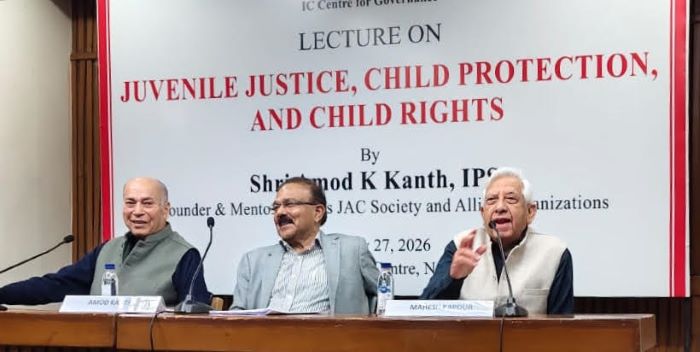
This reality surfaced yet again at a recent lecture at the India International Centre in New Delhi. The speaker was Amod K. Kanth, founder and mentor of Prayas JAC Society, addressing an informed audience on Juvenile Justice, Child Protection, and Child Rights. The gathering included members of the legal fraternity, activists, journalists, and civil society representatives—precisely the kind of audience one would expect to engage with systemic questions.
13 Years of the Indian Spring: Remembering Nirbhaya and the Awakening of a Nation
Kanth spoke about the philosophy behind juvenile justice. He argued that the very term “juvenile” carries colonial overtones, whereas Indian tradition has always regarded minors simply as children, differentiated only for technical legal purposes. He explained how the United Nations Convention on the Rights of the Child (UNCRC), ratified by almost every country in the world including India, shaped India’s Juvenile Justice framework. He also referred to a 2007 United Nations–Prayas study on child sexual abuse that eventually contributed to the enactment of the POCSO Act—now one of India’s strongest child protection laws.
The lecture was comprehensive. The legal architecture was laid bare. The philosophical foundations were explained. The reforms were contextualised.
And yet, when the floor opened for questions, the conversation circled back—once again—to the “minor” in the Nirbhaya case.
Four of the convicts were executed. One died by suicide. The sixth—being a minor at the time—was sent to a reform facility and released after completing the maximum three-year term prescribed under the law as it then stood.
Monday Musings: That makes three in a (death) row
Milord—Fourteen years later, we are still fixated on that one release.
Milord—We continue to blame the police, the judiciary, the lawmakers. But do we ask whether Delhi is safer today for women returning home from work at night?
Milord—Do we ask whether a woman stepping out at 9:30 pm—escort or no escort—feels secure?
Milord—Do we ask whether our homes have become safer spaces for women to assert their choices, especially when it comes to choosing a life partner?
Milord—In a nation that has seen women occupy the highest constitutional offices—President, Vice President, Prime Minister, Chief Ministers—why is the ordinary woman still negotiating for her right to walk freely after sunset?
Milord—Why, in a country where women were granted universal suffrage from the very birth of the Constitution in 1950, does marriage still translate into disproportionate domestic responsibility? Why does hospitality fall on her shoulders? Why is she expected to manage the education of children and maintain delicate family relationships across extended households?
Monday Musings: Prayas has its Thanks Giving day, courtesy Amod K Kanth
Our outrage, Milord, appears selective.
It is easier to demand the permanent incarceration of a single individual than to confront the deeper, more uncomfortable questions about patriarchy, policing, urban safety, social conditioning, and the everyday normalization of misogyny.
Justice was delivered within the framework of the law as it stood then. The law itself was amended after national introspection in 2013. But law alone cannot transform mindsets.
If fourteen years later our loudest question is still about the identity of a minor, then perhaps we have misunderstood the lesson of Nirbhaya.
The real issue was never just one individual.
The real issue was—and remains—the safety, dignity, autonomy, and equality of women.
That, Milord, is the case still pending before society.
Also Read more from this Author: Monday Musings: UNCRC is the Geeta,Quran and Bible of Child Rights
Curated By Humra Kidwai