Monday Musings: Guests Come and Go, Begging Is Permanent
Share, Comment, Like, and Subscribe to support Independent Journalism!
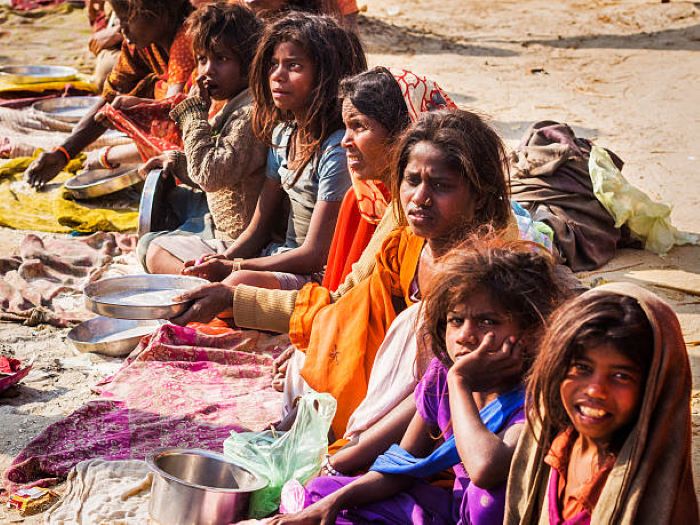
By Amitabh Srivastava, Edited By Adam Rizvi, The India Observer (TIO): Once again, the beggars on the streets of Delhi performed a vanishing act.
They were deemed an eyesore for the high-profile world leaders and industrialists attending the recent AI conference in a nation that aspires to become the world’s third-largest GDP within five years. It is another matter that media attention shifted swiftly to Orion, the robotic dog made in China, which reportedly refused to wag its tail when summoned by its alleged Indian handlers.
But back to the beggars — whose number, according to the 2011 Census (the last conducted), stands at 4,13,670, with the largest concentration in Uttar Pradesh and Bihar. This information was provided in a written reply by the Minister for Social Justice and Empowerment, Dr. Virendra Kumar, in the Rajya Sabha.
Syed Ali Mujtaba invited to discuss ‘Safeguarding Children in India’s AI Future.’
What happened recently in Delhi is not new. A similar cleansing occurred during the Commonwealth Games, and again in Gujarat during the Donald Trump visit for the “Howdy Trump” event in 2020.
The contradiction is stark. India boasts of becoming an economic powerhouse, yet it continues to operate under the shadow of the Bombay Prevention of Begging Act of 1959 — a draconian law that criminalised begging and made it punishable by imprisonment. Civil rights activists challenged this criminalisation, arguing that no one begs by choice. The Delhi High Court took a progressive step by effectively striking down key provisions of the Act, calling the criminalisation of begging unconstitutional.
Adding nuance to the debate, the Delhi Commission for Protection of Child Rights observed that child begging is sometimes portrayed as a survival strategy for families without alternative income sources.
Four women among 10 Muslim change-makers in Tamil Nadu
The Supreme Court of India adopted a more humane stance, stating that banning begging could only become a reality if the State first ensured proper rehabilitation and social security for those affected.
As of recent data, 20 States and 2 Union Territories have laws prohibiting begging. This technically means those found begging are to be “rescued,” housed in shelter homes, and rehabilitated.
To address the issue, the Ministry launched the SMILE scheme — Support for Marginalised Individuals for Livelihood and Enterprise — envisioning a “Bhikshamukt Bharat.” The scheme includes a Central Sector initiative for the comprehensive rehabilitation of persons engaged in begging. It is being implemented in 81 cities and towns of religious, historical, and tourist significance.
Budget 2026- Allocation of frugal funds for Minorities is an eyewash
The Ministry claims the focus is on rehabilitation through medical care, counselling, documentation, education, skill development, and economic linkages.
One of the states that initiated the scheme in 2024 is Kashmir, where Prayas JAC Society operates centres in both Kashmir and Jammu.
According to Mustafa, who runs the programme on behalf of Prayas, by December 31, 2025, they had surveyed 11,500 beggars, rescued 458, and rehabilitated 436 under various schemes. More significantly, they rescued 31 children — three enrolled in schools, one admitted to a drug rehabilitation centre, and 35 reunited with their families.
Yet, the programme faces practical challenges.
First, rescue operations often lead to litigation. Relatives of those detained sometimes file cases alleging illegal confinement, disrupting NGO efforts.
Mark Tully and the BBC radio were synonymous all over the subcontinent
The second challenge is more complex: many beggars resist rehabilitation because they reportedly earn far more through begging than through formal employment. It is commonly said that beggars outside religious places earn between ₹1,000 and ₹1,500 daily — rising to ₹4,000 per day during Ramzan, according to Mustafa.
In contrast, after training and placement, they might earn ₹20,000 to ₹25,000 per month.
Begging also carries a complicated cultural dimension. In some traditions, a bhikshuk is viewed as a renunciate — a person without worldly possessions who survives on alms.
A 2025 study by the Indian School of Public Policy cited a report by The New York Times that once described Bharat Jain of Mumbai as among the world’s richest beggars, reportedly earning ₹2,500 daily and amassing a net worth of approximately ₹7.5 crore ($890,000). He is said to own a two-bedroom flat and rent out shops for additional income.
Mozart of Madras AR Rehman creates a global dance anthem -‘Yethu’-
Little wonder, then, that organised rackets operate in several cities, collecting daily earnings from beggars and returning only a fraction. This phenomenon even found a humorous portrayal in a 1993 Bollywood film in which actor Annu Kapoor plays a beggar who runs a well-organised network while travelling in a luxury car, instructing his associates on how to maximise their takings.
But beyond satire lies reality. In Kashmir, police recently arrested a woman accused of running a beggars’ gang, collecting their daily earnings while positioning them strategically across the city.
Guests come and go. Global summits come and go. Cameras pan elsewhere.
But the question remains — is begging merely a law-and-order inconvenience to be hidden during state visits, or a mirror reflecting the uneven moral architecture of an aspiring superpower?
Epstein, Anil Ambani, and Unanswered Questions: Why India’s Prime Minister’s Office Must Clarify
Until rehabilitation becomes not just a scheme on paper but a viable alternative in practice, the vanishing act will continue — rehearsed each time the powerful arrive — while begging, as an institution, remains stubbornly permanent.